What If Parents Could See Their Children’s Future Before Making Major Decisions for Them?
Last updated:
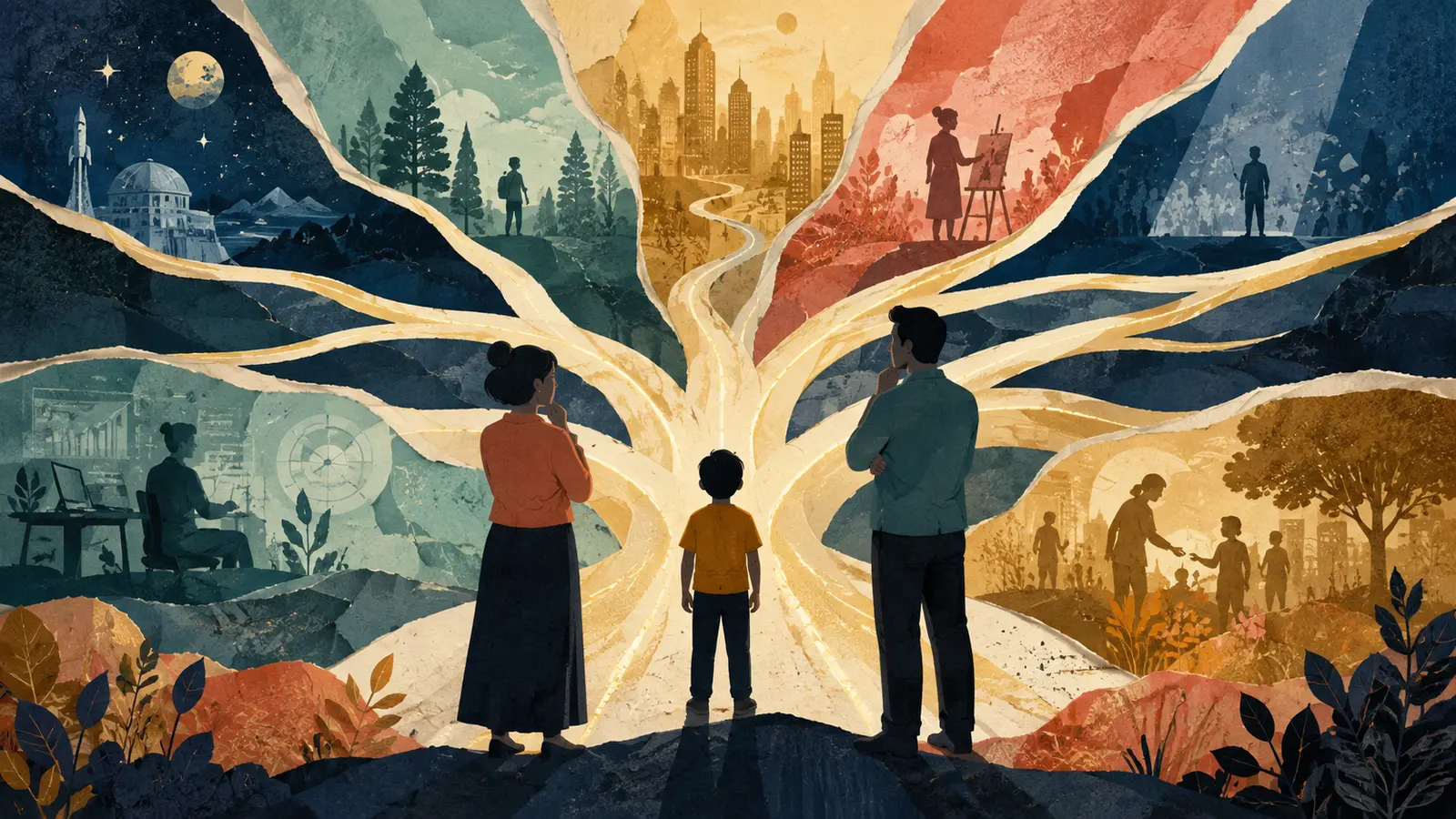
Mina and Daniel Ortiz are fictional parents raising fictional twelve-year-old Alex. Every future branch and event in this scenario is fictional. When the family faces a major decision, Mina and Daniel can view several possible futures. None is guaranteed, and each vision contains missing years, unseen causes and circumstances that may change. This is not prediction or individualized parenting, medical or legal advice.
The first decision produces three attractive fragments
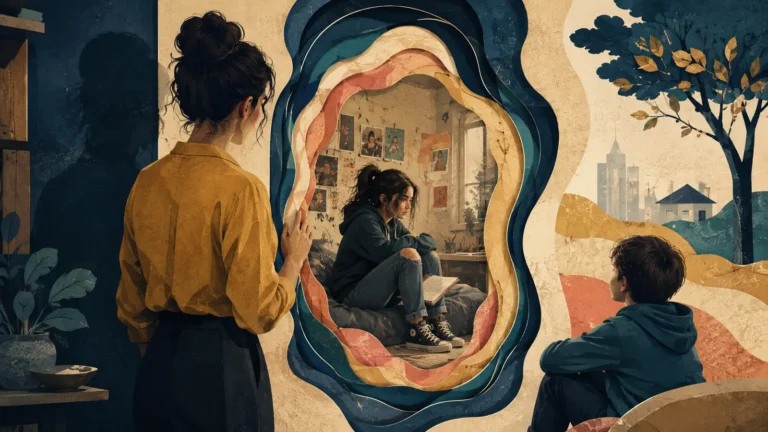
Alex may remain at the neighborhood school, transfer to a specialized arts program or join a smaller school offering more individualized support. The visions show three brief scenes. In one, sixteen-year-old Alex performs confidently in a crowded auditorium. In another, Alex laughs with longtime friends after class. In the third, Alex calmly presents a science project to a small group.
Mina immediately favors the auditorium. It looks like success: skill, recognition and opportunity. Daniel prefers the small classroom because Alex currently becomes tired in noisy settings and benefits from predictable routines. Neither parent knows what happened before or after the scene. The confident performance may follow years of stress; the calm presentation may be one ordinary day in a satisfying life.
Alex prefers staying with friends and attending an after-school art studio. The parents are tempted to treat the visions as evidence that Alex’s present preference is uninformed. Yet future knowledge that excludes the child’s voice is incomplete before any uncertainty begins.
They visit all three schools in the present. The arts program has a long commute and limited unstructured time. The smaller school offers useful supports but fewer electives. The neighborhood school has familiar staff and a crowded lunch period Alex finds exhausting. None of these facts appears clearly in the future scenes, and each could change next year. The visions do not remove the need to gather ordinary information.
A successful-looking future hides its definition
Mina requests more views of the arts program. She sees an award, a busy travel schedule and Alex greeting people at a gallery. She does not see whether Alex enjoys the work, feels pressured to continue or later chooses something unrelated. Visibility favors public achievements because they are easier to recognize than belonging, rest or private satisfaction.
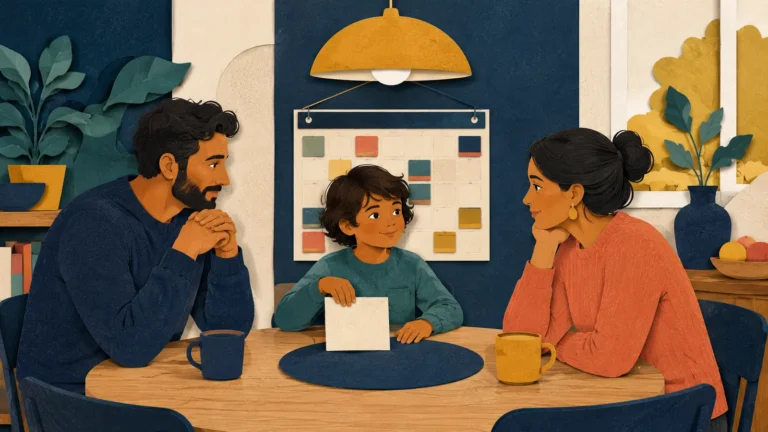
Daniel asks what counts as a good future. Mina names independence and opportunity. Daniel names stability and supportive relationships. Alex names enough time to draw without every drawing becoming an evaluation. The visions cannot rank those definitions. A branch may contain achievement and loneliness, support and boredom, risk and growth at once.
Relocation changes the meaning of every branch
Daniel then receives a possible job in another city. The move would change schools, housing, access to relatives and the support Alex currently uses. New future branches appear: Alex thriving in a new community, Alex returning to the old city as a young adult, and Alex staying while Daniel commutes.
The family cannot see the job ending early, a new teacher arriving, a relative needing care or Alex forming a friendship that changes the value of staying. Each decision reshapes later circumstances, so the school visions are no longer independent of the relocation. More branches create more information and more ways to pretend one incomplete scene settles the choice.
Daniel asks whether refusing the job closes an opportunity for the whole family. Alex asks whether accepting it makes one parent’s career the measure of everyone’s future. They compare income stability, housing, travel to relatives and the possibility of Daniel trying the role remotely first. A branch can show where someone arrives without showing who absorbed the cost.
Alex says moving now feels overwhelming. Mina hears fear and assumes the brave choice is to push through it. Alex corrects her: fear is part of the answer, not proof the answer is wrong. Opportunity belongs in the discussion, but so do attachment, energy and the cost of transition.
Trying to avoid one future begins creating it
One branch shows fifteen-year-old Alex isolated at the neighborhood school. Mina becomes determined to prevent it. She schedules extra activities, urges Alex to meet new groups and treats quiet weekends as warning signs. Alex starts hiding ordinary disappointments because every difficult day triggers another intervention.
The pressure reduces the unstructured time Alex once spent with friends. Invitations are declined for programs meant to prevent isolation. Mina has unintentionally begun creating the distance she feared. The vision did not cause the future, but treating it as a forecast altered present behavior.
Mina stops arranging additional activities without discussion. She apologizes for turning one possible scene into a diagnosis of Alex’s current social life. The apology does not mean she ignores genuine concerns. It restores a difference between asking how Alex is doing and treating every answer as evidence for a branch.
Disability and support are not failed futures
Alex uses sensory and organizational supports at school. In one future, those supports remain visible into late adolescence. Daniel initially describes the branch as less independent than the gallery future. Alex asks why receiving support counts as failure if it enables meaningful work, relationships and choice.
The question exposes another bias in the visions. Mina and Daniel notice assistance more readily than the inaccessible environments that make assistance necessary. A future with continuing support may be a good future. A future where support disappears may reflect changed needs, inadequate access or information the scene does not show.
The parents stop using apparent self-sufficiency as the automatic measure of success. They ask which environments let Alex participate, recover and make choices. The scenario makes no medical claim and does not treat one support plan as suitable for every child.
An extracurricular choice tests ordinary uncertainty
Alex must choose between the art studio and a robotics club scheduled at the same time. A future glimpse shows a prize from robotics. Another shows a lasting friendship formed at the studio. A third shows Alex quitting both and becoming absorbed in theater.
The parents cannot tell which choice led to theater or whether the prize mattered later. Alex chooses the studio because the instructor allows a trial month and friends already attend. The decision is not optimized for the most impressive scene. It is informed by current interest, accessibility, social comfort and the ability to revise.
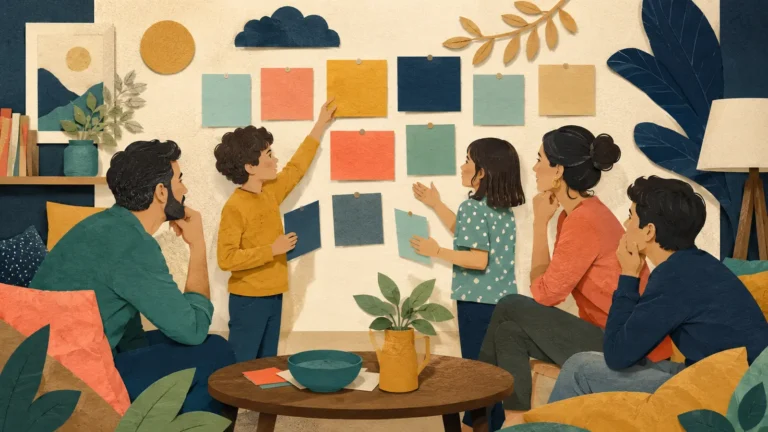
The family borrows a principle from the fictional month when children become household decision-makers: participation requires useful information, not just a vote after adults select the acceptable story.
They choose a reversible school decision
For school, the family declines to treat any vision as a command. Alex remains at the neighborhood school for the next term and joins the external art studio. The parents arrange a visit to the smaller program so it remains a real option rather than a threat used after a difficult week.
They set a review point after twelve weeks. The review will include Alex’s experience, teacher observations, workload, access to support and the family’s relocation decision. Alex may raise the question earlier. The parents retain responsibility for the final enrollment decision, but they commit to explaining how Alex’s preferences and present evidence shaped it.
The review is not a disguised countdown to the parents’ preferred transfer. Staying remains a possible outcome. If circumstances change, the family can bring the date forward rather than forcing Alex to endure a failing arrangement to prove the original decision wrong.
The process resembles the fictional right where children can appeal a family rule: participation does not guarantee the requested outcome, but it prevents authority from treating the child’s reasons as irrelevant.
Future knowledge cannot consent on Alex’s behalf
Mina and Daniel keep the ability to view branches but stop requesting one for every choice. Ordinary uncertainty is not a defect to eliminate. A decision can be responsible without proving it leads to the best visible outcome.
The branches help them ask better questions about opportunity, support, risk and whose definition of success is operating. They cannot reveal the experience between scenes, predict changing circumstances or replace Alex’s present consent where consent is appropriate.
The family ends with a reversible plan rather than a perfect future. The review point makes room for new information and for Alex to change. Knowing several possible destinations does not remove the need to travel with the person whose life is being decided.
Real-world context
Even perfect knowledge of a future outcome would not remove a child’s present rights or an adult’s safeguarding duties. The UN Convention on the Rights of the Child identifies both the child’s best interests and the child’s right to express views in matters affecting them. England’s Working Together to Safeguard Children guidance shows why protection also depends on current evidence, professional judgment and coordinated responsibility. These references reinforce the scenario’s focus on listening, uncertainty and review rather than treating a predicted future as permission to control.